 Home
HomeHow Do TWS Bluetooth Earphones Coordinate Two Buds, And Which Specs Matter?
 Sep 11,2026

 MiBA
MiBA
TWS Bluetooth earphones coordinate two independent buds through radio, audio, power, microphone, and charging systems whose real performance depends on verified design choices. The useful specification is not a single Bluetooth version or battery number; it is evidence that radio behavior, acoustic tuning, fit, controls, microphones, batteries, firmware, and the case have been tested together.
What “TWS” Changes Inside a Wireless Earphone System
The abbreviation describes true wireless stereo: there is no signal cable between the left and right earpieces. That freedom creates a distributed product with at least four cooperating devices—the phone, two buds, and charging case—rather than one simple headset. A buyer should understand each relationship before comparing headline claims.
The Radio Topology Is a System Choice, Not a Version Badge
A Bluetooth version indicates the core specification family supported by a chipset, but it does not prove which audio features a finished product enables. Classic Audio commonly transports stereo through A2DP, while newer LE Audio architectures can support separate synchronized streams and the LC3 codec when the source, chipset, profiles, firmware, and qualification all align. The Bluetooth SIG describes Multi-Stream Audio as a way to improve coordinated devices such as wireless earbuds, yet a product should not be assumed to support it merely because a component is capable.
Left and Right Playback Must Share Time, State, and Control
The two channels must start closely enough together that speech and music remain centered rather than drifting between ears. The buds also need a consistent record of volume, touch commands, call state, battery warnings, and which microphone is active. A robust true wireless stereo design manages those state changes when only one bud is removed, when one battery empties first, or when radio conditions become noisy.
How Audio Travels from a Phone to Both Ears
Codec Support Must Be Checked at Both Ends
A codec is usable only when both the source and the earphones implement a compatible option in the active operating mode. The baseline experience may differ across phones, computers, televisions, and gaming devices. LE Audio adds a different architecture and LC3, but current compatibility still depends on the complete source-to-sink chain. A credible earbud specification checklist should therefore name the tested source models, operating-system versions, selected codec or profile, and whether the result applies to music, calls, or both.
Latency and Call Quality Need Separate Test Methods
Latency is the total delay between an event at the source and sound at the ear. Video applications may compensate for predictable delay, while games and live monitoring expose it directly. A marketing phrase such as “low latency” is incomplete without the tested source, mode, codec, application, distance, and measurement method. Buyers should also record whether activating a microphone changes the audio profile or perceived fidelity.
Why Battery Numbers Do Not Predict Daily Endurance
Two Buds Create Two Independent Power Budgets
Each earbud contains its own cell and may consume power differently if one side handles more radio or microphone work. For TWS Bluetooth earphones, testing should record left and right shutdown times, not only the first low-battery warning. It should also define volume, content, codec, call share, ambient temperature, and whether optional processing was enabled. Those conditions turn an endurance claim into a repeatable result.
The Case Is a Charger, Enclosure, and Reset Point
Charging case design affects far more than storage. Contact geometry must tolerate repeated insertion; magnets must seat each bud consistently; the hinge and lid must survive routine handling; and the charging controller must avoid misleading indicators. A case that looks full may still leave one bud uncharged if its contacts are contaminated, misaligned, or mechanically shallow.
Fit, Controls, and Microphones Turn Electronics into a Usable Product
Fit Changes Bass, Isolation, and Voice Pickup at Once
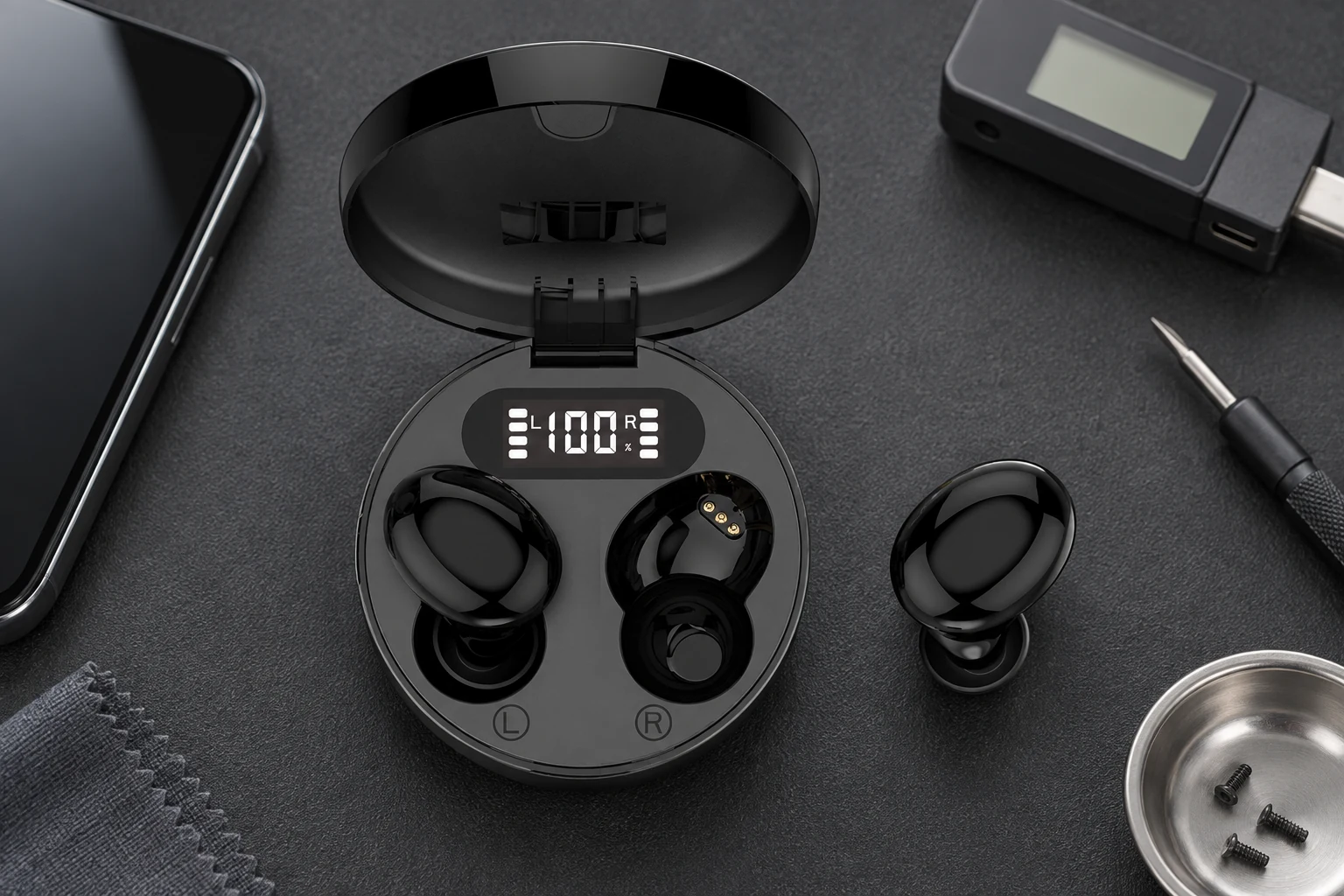
A weak seal usually reduces low-frequency response and passive isolation, which may encourage higher playback volume. A housing that rotates can also move microphones away from the intended angle. Sample evaluation should include multiple users and tip sizes, while a different housing example helps reviewers define which dimensions and wearing conditions must stay model-specific.
Color and finish options introduce their own verification needs. A pale coating, glossy black surface, or printed control icon may wear differently and expose molding marks differently. The site’s customized-pattern earbud page shows that appearance can be part of the offer, but any project should confirm an approved color standard, sample under controlled lighting, print area, abrasion expectation, and acceptable variation instead of relying on screen color.
Which Specifications Deserve Verification Before Shortlisting
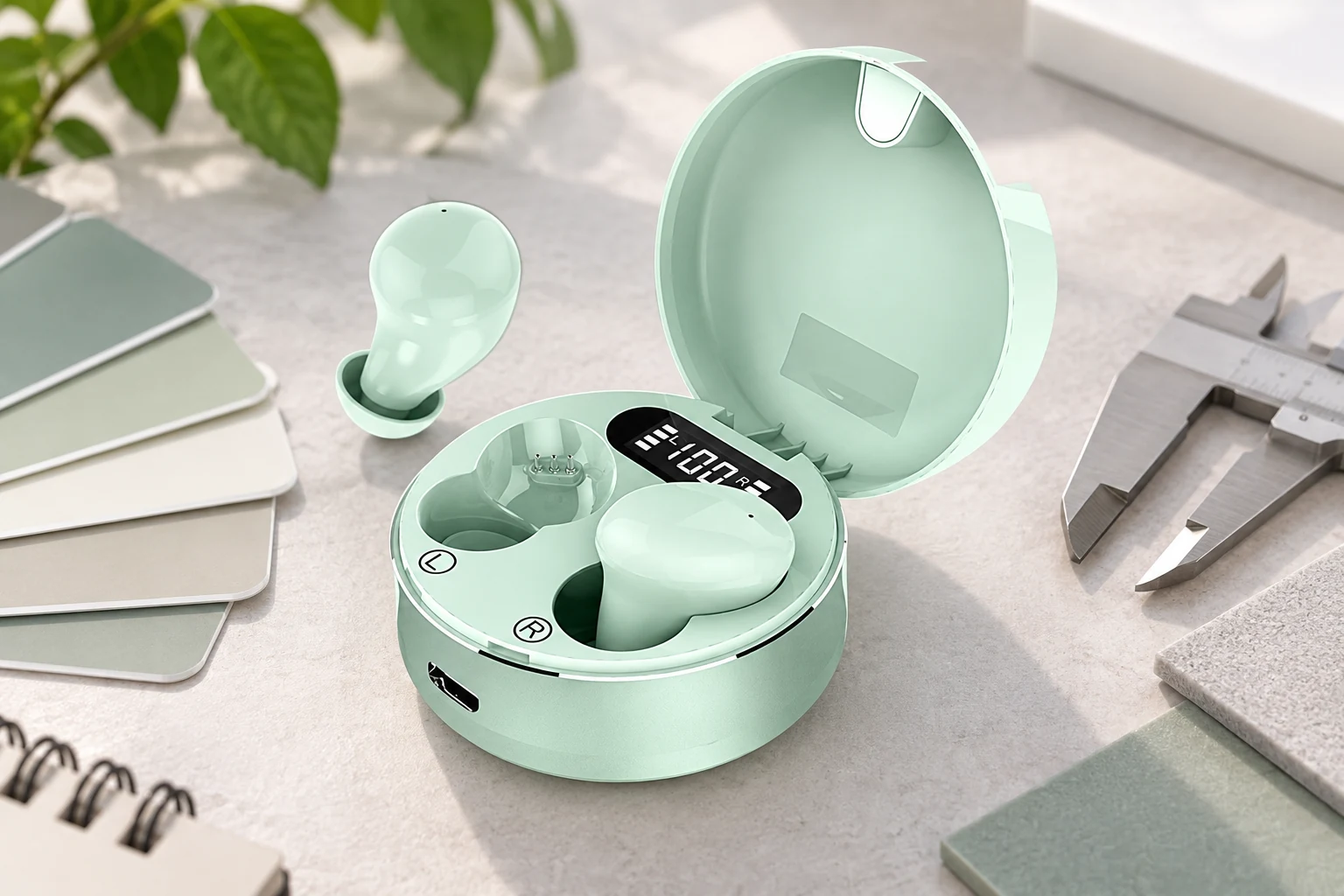
A specification table is most useful when it connects a claim to a test. An ultra-thin case example also shows why dimensions and mechanics must be verified per model. The framework below is not a promise about any one product.
| Area | What to Record | How to Verify | Common Misreading |
|---|---|---|---|
| Wireless link | Profiles, codecs, operating modes, source compatibility | Pair with a defined phone and computer matrix; log active modes | Treating a Bluetooth version as proof of every feature |
| Synchronization | Reconnect behavior, single-bud use, channel stability | Repeat transitions and interference scenarios | Judging only the first successful pairing |
| Audio | Frequency balance, output, distortion, seal sensitivity | Use level-matched listening plus objective measurements where available | Equating driver diameter or codec name with sound quality |
| Calls | Uplink intelligibility, artifact control, wind behavior | Capture far-end recordings in several environments | Assuming microphone count guarantees clear speech |
| Power | Per-bud endurance, case recharge cycles, standby drain | Run a documented duty cycle and record both buds separately | Converting nominal capacity directly into operating hours |
| Case | Contacts, magnets, hinge, indicator, input connector | Repeat insertions, charging recovery, and idle storage | Evaluating the case only as packaging |
| Mechanical | Fit, mass, finish, control force, ingress design | Use multiple wearers and inspect approved samples | Generalizing one wearer’s comfort to all users |
| Evidence | Reports, declarations, labels, manual, component traceability | Match document identifiers to the exact ordered configuration | Accepting a certificate image that refers to another model |
The strongest earbud specification checklist pairs each important requirement with a named sample, test condition, acceptable result, and document owner. A dense feature list without those links is difficult to audit.
How to Evaluate Samples Without Turning the Test into a Demo
A demonstration is designed to show a product under favorable conditions. Evaluation should expose transitions, limits, and repeatability. The goal is not to force every model through the same premium benchmark, but to test whether its stated use case is supported by consistent evidence.
A Small Matrix Produces Better Evidence Than One Long Listening Session
Start with two or three source devices that represent the intended environment. Define pairing, music, video, game or live interaction, call, range, obstruction, single-bud, recharge, and idle-storage checks. Repeat the short sequence on more than one unit when possible. Record firmware, serial or sample identifier, settings, time, and failure recovery so that another reviewer can reproduce the observation.
Production Evidence Should Connect Back to the Approved Sample
Once a sample is accepted, the specification, bill-of-material choices, appearance standard, packaging, firmware identifier, and inspection plan should be frozen at an appropriate level. A factory page can show general production context, while a certifications page may show available document categories; neither replaces order-specific evidence that the shipped configuration matches the approved unit.
Incoming and final inspections should emphasize functions that can drift: bud pairing, channel output, microphone operation, touch response, case charging, connector fit, indicators, cosmetic finish, accessories, and packaging count. Regulatory and conformity documents also need model identifiers, dates, scope, issuer details, and a match to the destination market. The EU Radio Equipment Directive is relevant background for radio products placed on the EU market, but responsibility and evidence should be confirmed for the exact product and supply arrangement.

Packaging and Shipment Checks Protect the Finished System
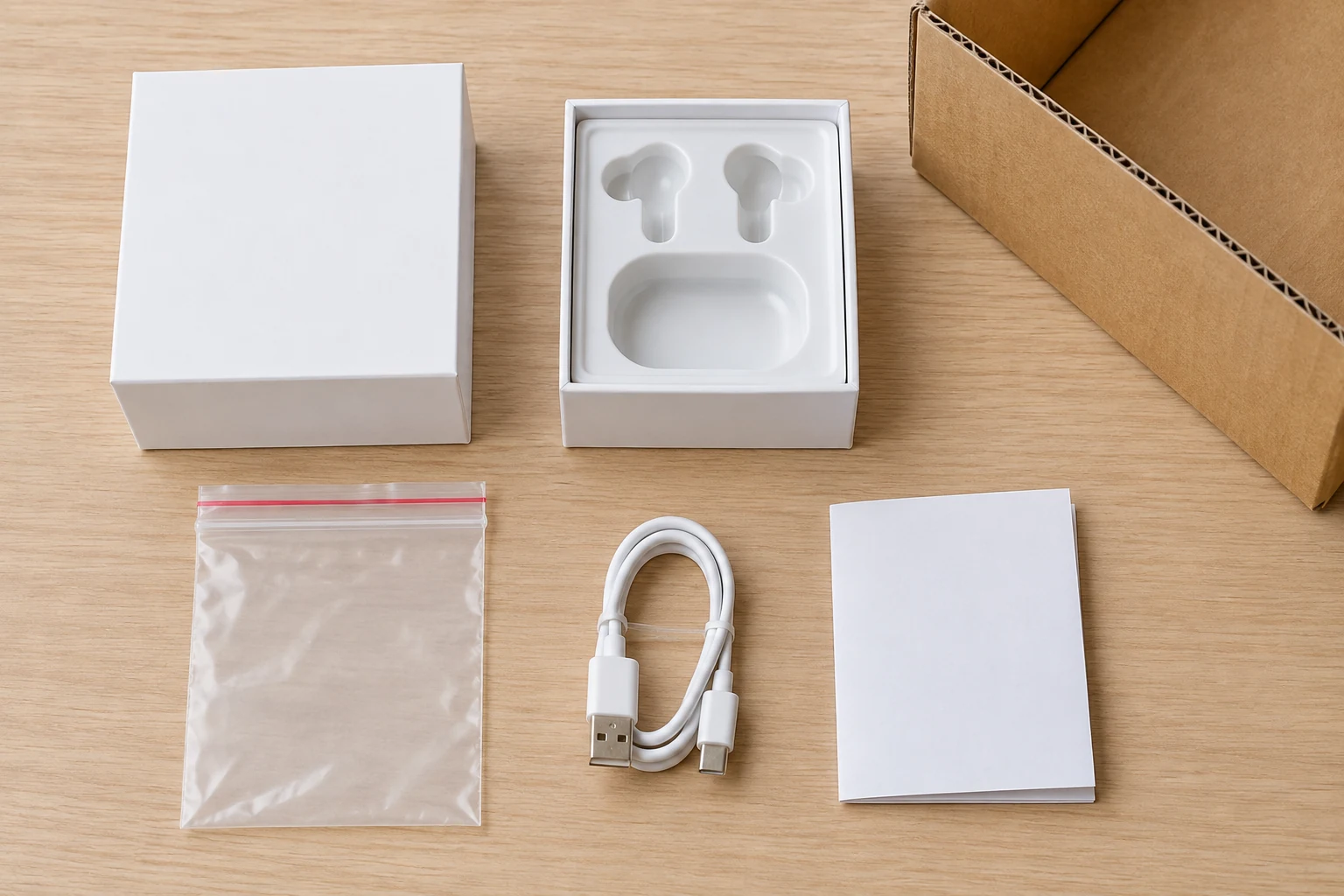
Earphones arrive with two buds, a case, cable, specified accessories, manual, inserts, and transport packaging. Verify every component against the approved list rather than a rendering.
Charging case design also influences the insert geometry and the risk of lid pressure during transit. Drop and vibration expectations should be chosen for the actual distribution route, pack quantity, carton strength, and product fragility. Blank or draft manuals should be checked for language, pairing steps, safety information, charging instructions, model identity, and disposal or compliance markings that are genuinely applicable. The same-site earbud range can help identify alternative form factors, but packaging dimensions must come from the approved model.
Frequently Asked Questions
Does Bluetooth 5.0 Mean the Earphones Support LE Audio?
No. LE Audio relies on specific Bluetooth Core features and a set of audio profiles and services, while a version label alone does not confirm their implementation. Ask for the exact supported profiles, codec behavior, qualification evidence, firmware status, and a test on the intended source device.
Why Can the Two Buds Have Different Battery Life?
They may perform different radio, microphone, control, or processing work, and their cells may not be perfectly matched. Wearing conditions and signal obstruction can also differ by side. Record left and right endurance separately under the same defined duty cycle.
Is a Larger Driver Always Better?
No. Driver size is only one design variable. Diaphragm behavior, acoustic volume, vents, seal, tuning, amplification, distortion control, and production consistency determine the result together. Compare level-matched samples rather than ranking products by diameter alone.
What Should Be Included in a First Sample Report?
Include the sample identifier, firmware, source devices, pairing and reconnect results, active modes, audio and call observations, per-bud endurance, case behavior, fit notes, control response, finish, accessories, packaging, failures, and photos. Link each result to an acceptance requirement.
How Many Units Are Needed for Evaluation?
One unit can reveal obvious design issues but cannot show consistency. The appropriate count depends on decision risk, project stage, test type, and expected variation. Use multiple units for repeatability and define a statistically justified inspection plan before mass production.
A Useful Earphone Specification Is a Verified System
The right conclusion is not that one codec, battery size, or housing shape makes every pair superior. TWS Bluetooth earphones perform well when the wireless topology, acoustic system, fit, microphones, controls, two power budgets, and charging case design work together on the intended source devices. A disciplined review converts each claim into a condition, method, and acceptable result. That approach makes product differences visible, keeps regulatory evidence tied to the exact model, and gives later production checks a clear reference instead of a collection of unconnected marketing numbers.
 Which Evidence Supports A Bluetooth Charger Best Manufacturer Claim?
 You May Also Like


 Tel
Tel
 Email
Email
 Address
No.602,BldA Shanhai Building,Bantian Street,Longgang District,Shenzhen City,Guangdong Provice,China