 Home
HomeWhat Makes A Bluetooth Charger Best Manufacturer Shortlist Defensible?
 Sep 15,2026

 MiBA
MiBA
A bluetooth charger best manufacturer shortlist needs traceable safety, compatibility, process, sample, and change-control evidence—not a supplier claim alone.
Define The Product Before Ranking The Supplier
“Bluetooth charger” may describe a wireless charging device combined with a speaker, clock, light, or other function. Those combinations change power architecture, firmware, thermal behavior, user controls, labeling, packaging, and applicable requirements. Buyers should freeze the intended functions, charging interfaces, supported devices, market, accessories, materials, finish, and retail presentation before comparing factories.
A Reference Configuration Prevents Hidden Comparisons
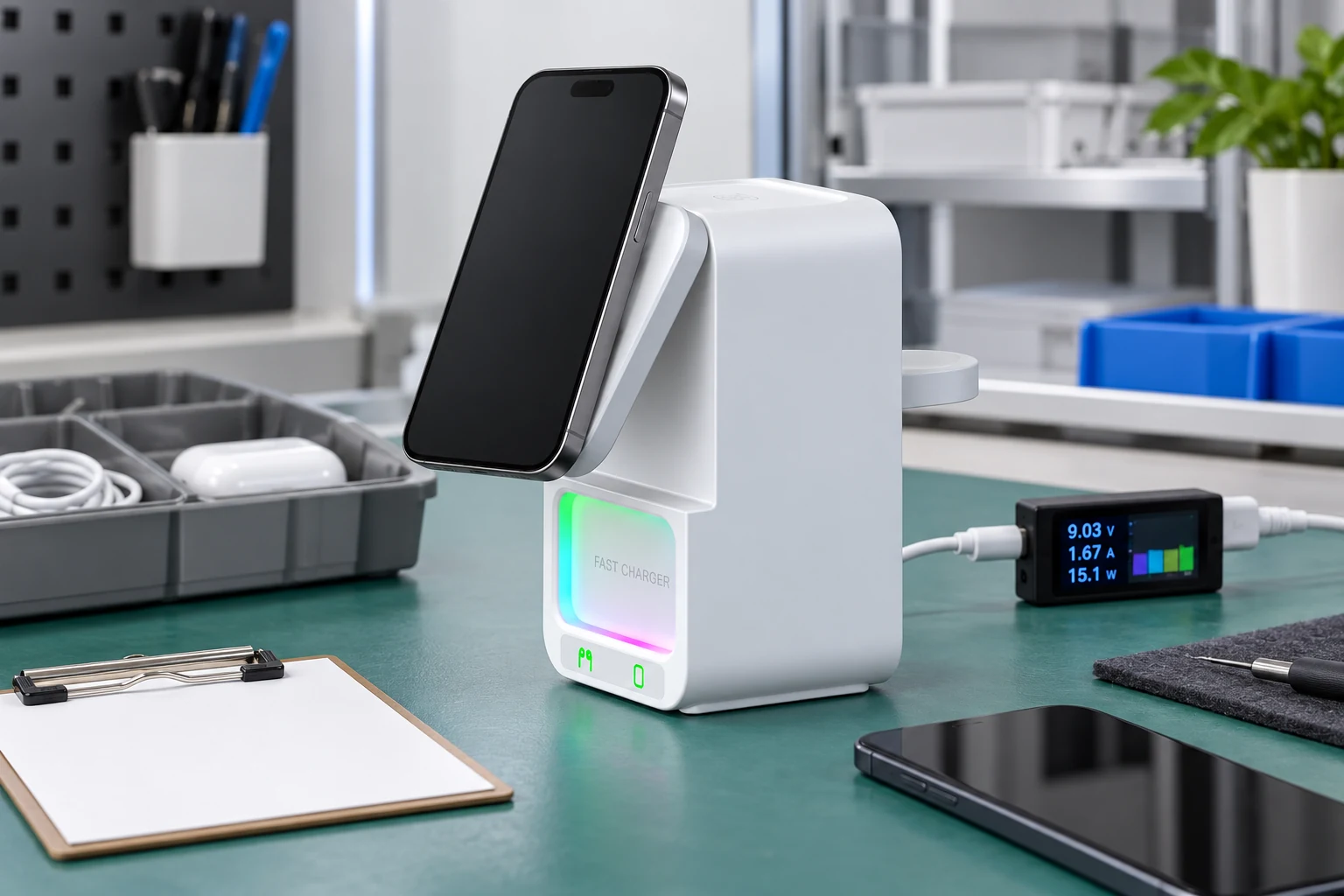
Assign one identifier to the reviewed configuration and link it to drawings, bill-of-material boundaries, firmware, wireless module, charging coil, power input, cable, adapter assumptions, cosmetic standard, package artwork, and instructions. Suppliers may propose alternatives, but each deviation should be visible beside its reason and test impact. MiBA's current 5-in-1 wireless charger speaker page is a concrete product reference; purchase acceptance still requires the exact offered revision.
Claimed Wattage Needs A Complete Power Path
A rated charging value does not describe the input supply, cable, protocol negotiation, device alignment, concurrent speaker or lighting load, temperature limits, or sustained output. Request the declared input profile and define which functions operate together. A sample should be tested with representative power sources and loads, including a stable condition long enough to expose thermal or control limits.
Compliance Starts With Scope, Not A Certificate List
Market requirements depend on product category, radio functions, power architecture, materials, packaging, claims, and destination. A certificate logo is not enough. Ask which model and revision were tested, which standards and editions applied, which laboratory issued the report, and whether production remains within that evidence. MiBA's certifications page supplies site context, not automatic product approval.
European Charging Rules Need Product-Specific Interpretation
The European Commission states that common-charger rules apply to listed categories of radio equipment and emphasize USB-C, fast-charging interoperability, consumer information, and unbundled charger choices. A multifunction device should be classified with competent compliance support rather than assumed to fit a rule because it charges a phone. Record the legal role of the importer, manufacturer, and brand owner, plus the technical documentation expected before placing the product on the market.
Safety Evidence Must Match The Actual Charger Boundary
IEC 60335-2-29 covers particular safety requirements for certain household and similar battery chargers within its stated scope. That does not mean it automatically governs every wireless charging accessory or every multifunction product. The supplier should map applicable safety, radio, electromagnetic compatibility, chemical, energy, labeling, and waste obligations to the exact design. Any exclusion needs a documented rationale, not silence.
Use One Evidence Matrix Across All Candidates
A supplier evidence matrix separates facts from promises and makes missing proof comparable. Each row should name the requirement, configuration, owner, document or test, revision, limit, status, and open action. It can cover product, process, compliance, packaging, capacity, continuity, and terms without hiding uncertainty in one score.
| Decision Area | Evidence To Request | Verification Method | Common Gap | Decision Use |
|---|---|---|---|---|
| Configuration control | Drawing, BOM boundary, firmware and sample ID | Cross-check identifiers | Sample revision is not recorded | Prevents evaluating the wrong build |
| Safety and market scope | Applicable-requirements map and reports | Review scope, model and lab | Report covers a related model | Identifies evidence still required |
| Charging behavior | Device, adapter, cable and temperature matrix | Repeatable bench tests | Only one phone is tested | Shows compatibility boundary |
| Production control | Process flow, work instructions and test limits | Audit and witness run | Final test has no retained data | Links design to repeatable output |
| Change management | Approval route and traceability records | Scenario walkthrough | Substitution can occur without notice | Protects the approved configuration |
Weighting should follow the buyer's real loss exposure. Safety, regulatory scope, function, and unauthorized change may be decision gates; cosmetic consistency, packaging productivity, or lead time may be scored trade-offs. State which criteria are mandatory before reviewing supplier names.

Compatibility Testing Must Reproduce The Intended Use
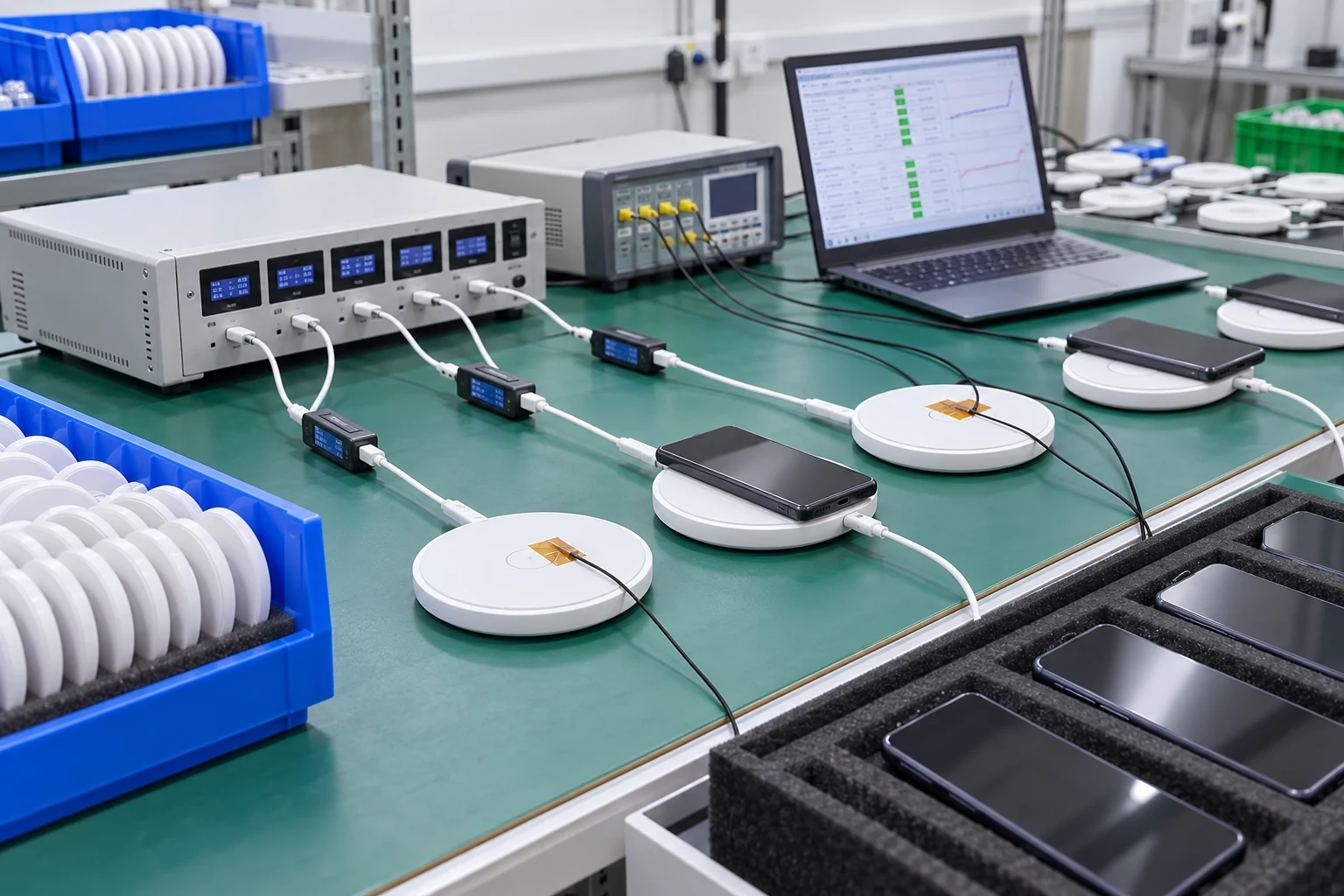
Wireless charging is sensitive to device geometry, coil alignment, cases, foreign objects, input power, thermal conditions, and concurrent functions. A charging compatibility test should define the device models, case thickness, initial battery state, adapter and cable, ambient condition, placement attempts, charge duration, functions running, measurements, and endpoint.
Pass Conditions Need More Than A Charging Icon
An icon can appear while power is low, cycling, or interrupted. Record negotiated input, delivered power where measurable, temperature, charging continuity, alignment tolerance, restart behavior, and any user indication. Repeat placement rather than relying on one ideal position. Include representative smaller and larger devices, and separate an unsupported combination from an intermittent failure.
Multifunction Loads Should Be Tested Together
A speaker, light, clock display, second charging output, or wireless connection may compete for input power or alter temperature. Test the combinations promised to users, not only each feature alone. Include power interruption and reconnection, control conflicts, audio noise while charging, indicator behavior, and recovery after a protection event. MiBA's product directory shows multiple electronic categories, but behavior cannot be transferred between models without current evidence.
A Factory Audit Should Follow The Product Route
A general tour does not show how the target configuration is controlled. Follow one unit through incoming components, assembly, firmware, functional checks, cosmetic inspection, packaging, quarantine, rework, and release. At each step, ask how operators identify the current instruction, limit, record, and failure action. A bluetooth charger best manufacturer decision needs this witnessed product route.
Incoming Controls Should Focus On High-Risk Parts
Charging coils, power-management components, wireless modules, batteries where present, cables, plastics, magnets, adhesives, displays, and speakers can affect function or compliance. The control plan should identify approved sources, incoming checks, sampling, storage, lot identity, and escalation rules. Not every part needs the same inspection depth, but every reduced check should have a risk basis and supplier-performance history.
End-Of-Line Tests Need Limits And Retained Identity
“Function tested” is ambiguous unless the station defines fixtures, software, sequence, limits, calibration, operator action, and data retention. Confirm that a failed unit cannot silently return to the good flow and that rework is reverified. MiBA's factory overview provides site context; the audit still needs a witnessed route for the exact charger configuration.
Samples Should Reduce Uncertainty In Stages
One sample cannot represent process variation. Use an engineering sample, a corrected sample, a golden sample, and a pilot run. Each stage should name quantity, purpose, revision, deviations, test plan, disposition, and approval authority. MiBA's download library may supply supporting material, while the sample record controls the actual decision.
A Golden Sample Needs Version And Custody
Identify hardware, firmware, color, finish, markings, accessories, package, instructions, and date on the approved sample. Keep controlled units with both buyer and supplier when practical, and define what photos or measurements supplement the physical reference. Damage, replacement, or software update should trigger a recorded action. Without custody, “same as sample” becomes an unverifiable memory.

Change Control Protects The Evidence After Approval
An initial evaluation can be undone by an unapproved component, firmware, material, tooling, site, sub-supplier, or package change. The change-control record should identify the revision, reason, affected lots, risk, updated documents, validation, approval, implementation date, and traceability.
Substitution Rules Should Be Agreed Before Shortage
Supply disruption creates pressure to move quickly. Define which parts may never change without approval, which equivalents need document review, and which require full or limited retesting. Require the supplier to preserve affected stock and lot identity until the decision is made. A fast, explicit route is safer than a blanket prohibition that teams bypass when production is urgent.
After mass production begins, monitor incoming defects, charging interruptions, temperature findings, cosmetic trends, returns, rework, line failures, and unauthorized deviations by lot and revision. Supplier performance should improve the next audit and sampling plan. A stable history can justify focused inspection; a drifting history should increase evidence depth rather than merely lower a score.
The Best-Manufacturer Claim Is A Decision Boundary
The practical question is not whether one factory is universally best. It is whether a bluetooth charger best manufacturer candidate has supplied enough current, configuration-specific evidence for this product, market, volume, and risk profile. The answer may change when the specification, destination, supplier site, or approved component set changes.
Keep the decision reversible: state mandatory gates, scored trade-offs, unresolved risks, compensating controls, and the evidence expiry or review trigger. That turns a ranking into an auditable sourcing decision and makes later performance comparable with the reasons the supplier was selected.
Frequently Asked Questions
Can a certificate prove that a supplier is suitable?
No. It may support one compliance question when its scope, model, revision, standard, lab, and validity match the product. Supplier suitability also depends on configuration control, production evidence, capacity, continuity, quality response, and change management.
How many device models should charging tests include?
Choose a risk-based matrix representing intended users, device sizes, operating systems where relevant, cases, power sources, and important edge conditions. Record what remains outside the tested boundary instead of implying universal compatibility.
What should be checked during a pilot run?
Verify material identity, work instructions, fixtures, cycle time, yield, defect handling, test data, cosmetic limits, packaging, traceability, rework, and whether the golden sample matches production output.
Why is the product revision important?
A test result applies to the tested configuration. Hardware, firmware, coil, power component, plastic, cable, adapter assumption, or packaging changes can alter function, safety evidence, appearance, or user information.
When should a supplier be re-evaluated?
Re-evaluate after significant changes, repeated defects, a new production site, major volume growth, expired or changed compliance evidence, performance drift, ownership or process disruption, or a market requirement that changes the accepted boundary.
For a comparable shortlist, issue one shared configuration pack, device matrix, sample plan, pass limits, and change route through the quotation sheet before candidates submit evidence.
 TWS Bluetooth Earphones Stay Predictable When Fit, Links, And Charging Are Tested
 You May Also Like


 Tel
Tel
 Email
Email
 Address
No.602,BldA Shanhai Building,Bantian Street,Longgang District,Shenzhen City,Guangdong Provice,China